
 Speak to a Rep:
.png)
Call centers are reporting declining connection rates, lower answer rates, and rising difficulty reaching homeowners, even when lead volume remains stable.
The assumption is often that lead quality has declined.
But the real problem is deeper. Calling infrastructure has changed.
Following major FCC enforcement updates in 2025, alongside stricter carrier authentication standards and native smartphone spam filtering updates, outbound dialing is no longer judged purely on volume. It is judged on trust, verification, and reputation.
What Changed In Outbound Calling
 The biggest shift is that phone numbers now operate a lot like email domains.
Reputation matters.
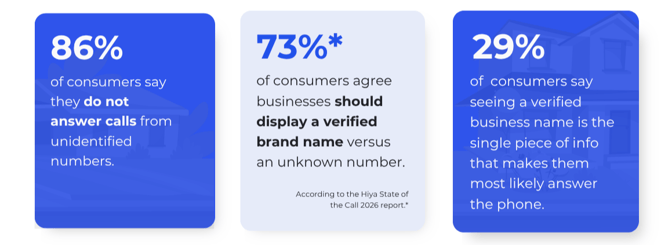
According to Hiya's State of the Call 2026 industry data:
- 86% of consumers do not answer unknown calls.
- Seeing a verified business name is the number one factor (29%) that makes consumers most likely to answer a business call . Furthermore, 73% of consumers agree that businesses should identify themselves on caller ID when they call.
If your numbers are unregistered, flagged, or poorly authenticated, calls may be filtered or labeled as spam before the consumer even decides whether to answer.
The 3-Point Contactability Audit Framework
We recommend running a Contactability Audit to maximize outreach effectiveness.
1. Reputation & Registration Audit
First, understand how your outbound numbers actually appear to carriers and consumers.
Questions to evaluate:
- Are your calls being labeled “Spam Likely”?
- Are your numbers properly registered?
- What attestation level are your calls receiving?
- Are certain campaigns seeing lower answer rates than others?
2. Channel Dependency Audit
The second step is evaluating how dependent your outreach strategy is on outbound voice alone.
Many contact centers still rely almost entirely on phone calls. That creates risk in today’s filtering environment.
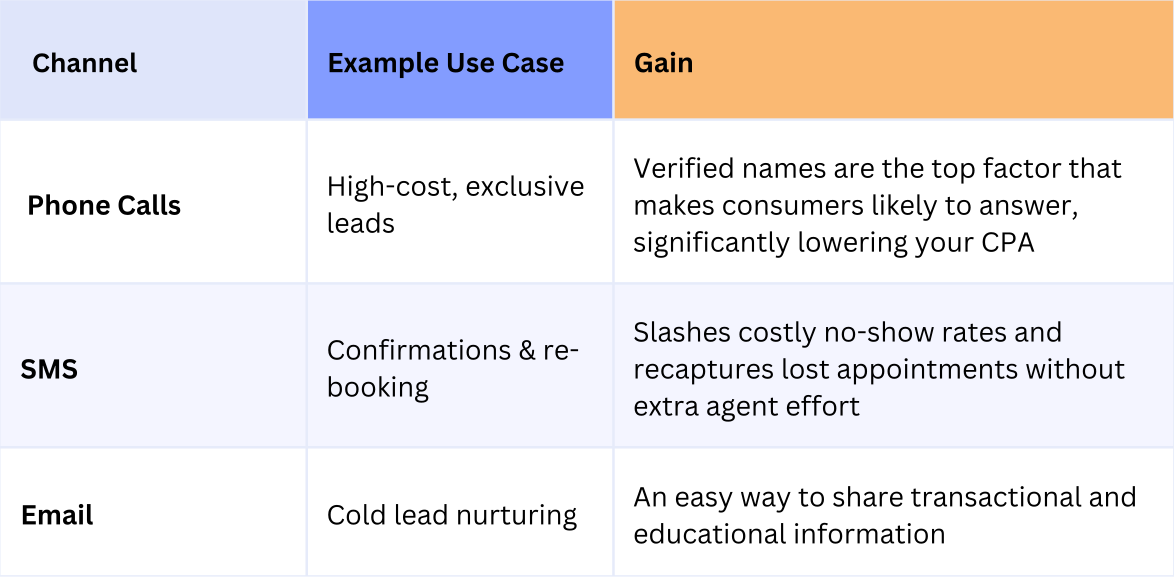
We recommend auditing your full communication journey and identifying where additional touchpoints can support outbound dialing, including:
- SMS confirmations
- Pre-call text reminders
- Email nurture sequences
- Branded recognition messaging
That small recognition layer can materially improve answer rates.
3. Contact Rate Benchmark Audit
The final step is benchmarking your current performance against historical baselines.
This helps identify whether:
- Carrier filtering is impacting performance
- Certain numbers have poor reputation health
- Operational inefficiencies inside the contact center are affecting results
We recommend tracking:
- Answer rate
- Contact rate
- Appointment-set rate
- Speed-to-lead
- Call-to-appointment conversion
Why Multi-Channel Systems Are Outperforming
At scale, dialing into the void kills profitability. Top contact centers use multi-channel systems to protect their sender reputation, filter out low-intent leads, and maximize agent talk time.
 The goal is not to stop dialing.
It is to increase the probability that homeowners recognize, trust, and answer.
The Strategic Shift Happening Now
The contractors maintaining stronger appointment rates are operating with more visibility into their outbound infrastructure, monitoring reputation proactively, and building multi-channel systems that reduce friction before the call even happens.
If you want to improve outbound performance, HomeBuddy can help. From exclusive leads, booked appointments and call center support, we help contractors improve conversion efficiency in today’s evolving outbound environment.
.svg)
.svg)